 Back to News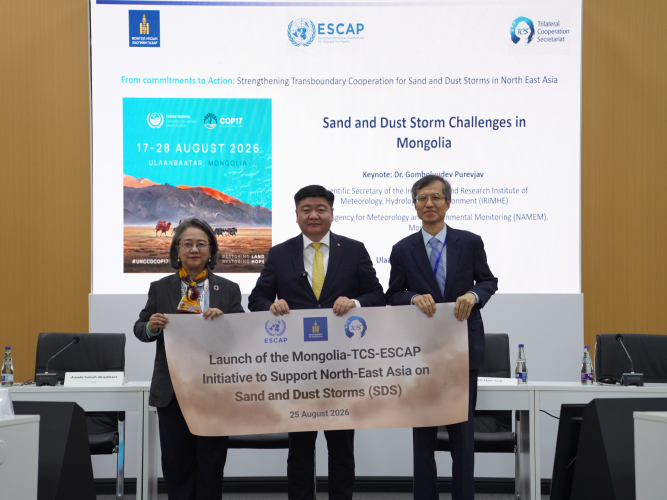
Mongolia, ESCAP and TCS launch joint initiative on sand and dust storms on the margins of UNCCD COP17
The Government of Mongolia, the United Nations Economic and Social Commission for Asia and the Pacific (ESCAP) and the Trilateral Cooperation Secretariat (TCS) today jointly launched the “Mongolia-TCS-ESCAP Joint Initiative on Addressing Sand and Dust Storms (SDS) in North-East Asia” at a side event on the margins of the seventeenth session of the Conference of the Parties to the United Nations Convention to Combat Desertification (UNCCD COP17). Supported by the three partners, the initiative aims to establish a comprehensive framework to mitigate the severe environmental, socio-economic and public health threats posed by transboundary sand and dust storms in the subregion.
Sand and dust storms have become an increasingly complex hazard in North-East Asia, driven by accelerating desertification, unsustainable land use, and climate change. By degrading air quality, disrupting critical infrastructure, and threatening public health, SDS presents a challenge that no single nation can tackle alone. This initiative operationalizes the "Trilateral + X" framework—reaffirmed by the 9th China-Japan-ROK Trilateral Summit— fostering closer cooperation with Mongolia to advance shared priorities on regional resilience.
To be implemented in close coordination with other UN and non-UN partners, the initiative will explore four strategic pillars: a) integrated impact-based forecasting and early warning systems, b) risk assessments, studies and impact analysis, c) community-level preparedness, and d) regional coordination, knowledge platforms and high-level engagement. Initial efforts will focus on Pillar 1, with a view to strengthening forecasting capacities and advancing the translation of hazard information into actionable risk intelligence. By upgrading standard operating procedures and improving multi-hazard early warning architecture, the partnership establishes an upstream "early action" mechanism that will safeguard communities across the region.
“Today, sand and dust storms are no longer simply environmental or climatic hazards. They have become a strategic challenge posing serious risks to economic growth, social stability, public health, and food security across the region. We cannot address this transboundary environmental challenge through the efforts of any single country. It requires strong political leadership at the regional level and the support of multilateral cooperation,” said Sandag-Ochir Tsend, Minister of Environment and Climate Change of Mongolia.
"The significance of today’s launch extends beyond the establishment of a new initiative. It demonstrates how existing political commitments, subregional mechanisms and technical capacities can be successfully leveraged around a defined programme of cooperation. It also reflects the role of ESCAP as a regional platform: to connect national priorities with subregional and regional action; to bring policy and technical communities together; and to facilitate continuity from dialogue to implementation,” shared Armida Salsiah Alisjahbana, Under-Secretary-General of the United Nations and Executive Secretary of ESCAP.
Lee Hee-Sup, Secretary General of the Trilateral Cooperation Secretariat, further underscored: “Sand and dust storms are a shared regional challenge that calls for different experiences and approaches to come together. Across North-East Asia, countries have developed valuable experience, technologies, and approaches in areas ranging from land restoration and monitoring to early warning and community resilience. The value of the ‘Trilateral + X’ approach is to bring these complementary strengths together, connect existing efforts, and turn them into greater collective impact. TCS welcomes the opportunity to work with ESCAP and the Government of Mongolia through this Joint Initiative, and we hope it will provide a practical platform for partners to build on what already exists and explore new opportunities for cooperation.”
###
About MECC Mongolia: The Ministry of Environment and Climate Change of Mongolia leads national efforts on climate change adaptation, desertification control, and environmental protection, while coordinating key environmental initiatives across the country.
About ESCAP: The Economic and Social Commission for Asia and the Pacific (ESCAP) is the most inclusive intergovernmental platform in the Asia-Pacific region. The Commission promotes cooperation among its 52 member States and 9 associate members in pursuit of solutions to sustainable development challenges. ESCAP is one of the five regional commissions of the United Nations.
About the TCS: The Trilateral Cooperation Secretariat is an international organization established with a vision to promote peace and common prosperity among the People's Republic of China, Japan, and the Republic of Korea